





Table of Contents
When it comes to messaging campaigns, understanding prohibited messaging practices is more than a best practice—it’s a legal requirement.
Governing bodies like the CTIA (Cellular Telecommunications Industry Association) and the TCPA (Telephone Consumer Protection Act) enforce strict rules to protect consumers from spam, misinformation, and other harmful messaging practices.
This guide walks you through prohibited messaging practices, prohibited content, and how CallHub helps keep your campaigns compliant.
Prohibited messaging practices you need to know
Understanding prohibited messaging practices and the rules that regulate communication is essential. Let’s examine these rules and how they help maintain a healthy messaging environment.
Here’s what you need to know:
1. Sharing, selling, or renting consent
Consent to receive messages is specific to the entity that obtained it. The CTIA and TCPA prohibit the sharing, selling, or renting of this consent to other organizations or entities.
This means that if a customer has given consent to receive messages from one brand, that consent cannot be transferred or sold to another brand or third party. Violating this prohibition can result in significant fines and legal repercussions.
2. Phishing as prohibited messaging practices
Phishing involves sending messages that appear to originate from reputable companies to deceive recipients into disclosing sensitive information, such as passwords and credit card numbers.
3. Snowshoeing
Snowshoeing refers to the use of multiple source numbers to distribute messages in an attempt to circumvent spam filters. All operators ban this practice due to its impact on deliverability, and campaigns or accounts may be suspended.
4. Filter evasion and number cycling
Filter evasion involves replacing blocked phone numbers with new ones to evade filters. On the other hand, number cycling involves discarding numbers with poor deliverability and replacing them with new ones, which can result in a negative user experience and may raise consent or message quality issues.
These are common prohibited messaging practices that can quickly trigger carrier scrutiny
5. Grey route
When you send a message from your campaign, it passes through your network carrier and is then delivered to the recipient via the destination carrier.
However, there are cases where messages intended for a recipient within the same country are routed through international carriers before returning to the original country.
This process, known as grey routing, is typically used to reduce messaging costs and, in some cases, to bypass certain telecom regulations.
While grey routing isn’t entirely illegal, it does violate specific telecom regulations designed to prevent the misuse of messaging systems. Messages sent through a grey route may incur a $10 penalty per message.
6. Dynamic routing
Ensure that each phone number follows a singular delivery route. Dynamic routing to bypass spam-blocking mechanisms is prohibited and may result in the disabling of messaging campaigns.
7. URL redirects and forwarding
Message senders must ensure that any website links in their messages represent the sender’s identity and are not meant to deceive or harm recipients. When using URL shorteners, the shortened link must be associated with the sender’s dedicated domain or IP address.
The web addresses within the messages and the websites they direct to should transparently disclose the website owner (either an individual or a legally registered business entity) and provide contact details, such as a postal mailing address, to ensure complete transparency.
Avoid including URLs in messages that redirect through multiple layers, as this can obscure the final destination and result in immediate service suspension.
| Other common mistakes to avoid in SMS compliance 1. Opt-out requests must be processed immediately. 2. Businesses must obtain express written consent before sending automated messages. 3. It is required to inform recipients of any applicable message and data rates and to disclose the frequency of messages. 4. Accurate records of all consents and opt-outs are essential for compliance. Proper documentation is necessary for legal disputes and audits, and it helps businesses demonstrate compliance with TCPA regulations. Note: This information is sourced from the CTIA Messaging Guidelines and TCPA Compliance. Many prohibited messaging practices also stem from poor recordkeeping and weak consent management. |
Run compliant campaigns with confidence. CallHub automates opt-outs, filters prohibited content, and handles 10DLC registration for political and nonprofit teams. Talk to our expert now.
Prohibited message types in your campaigns

These restrictions are in place to protect consumers from harmful, misleading, or offensive content.
The following are some of the primary prohibited message types:
1. Profanity and inappropriate language
Messages containing vulgar, obscene, or inappropriate language are strictly prohibited. Carriers can block messages containing profanity and penalize the sender.
2. SHAFT as prohibited messaging practices
SHAFT stands for the five content categories that are completely off-limits in carrier messaging:
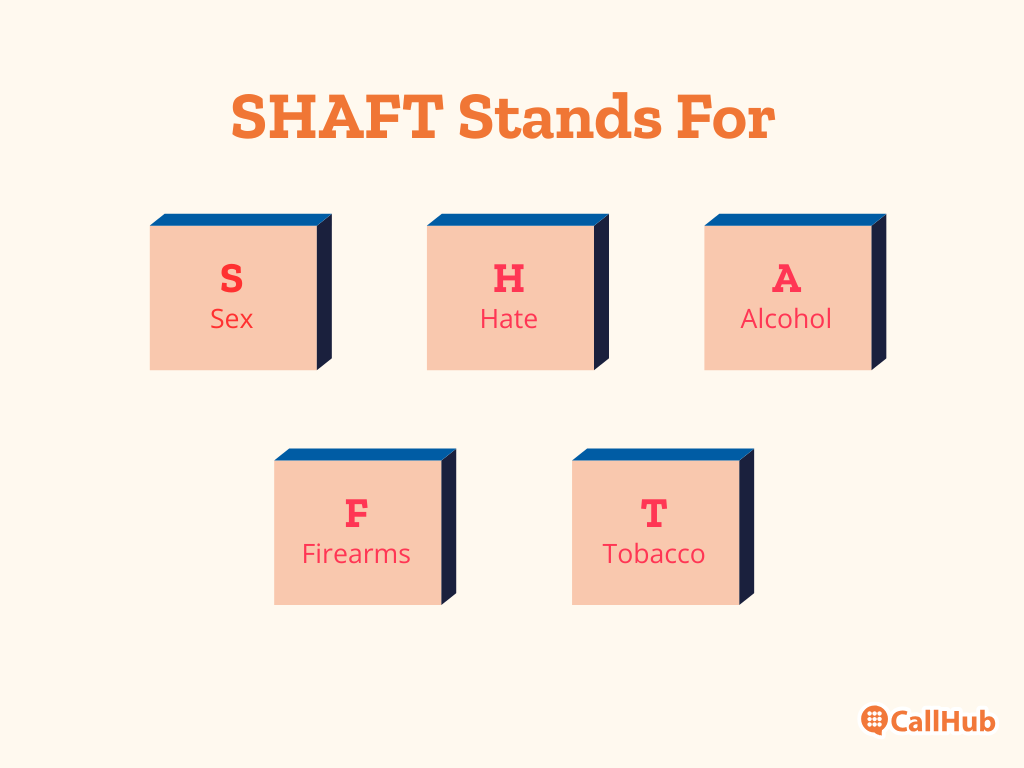
This includes
- Messages about adult entertainment and violence.
- Messages that contain hate speech, discriminatory language, or promote violence against individuals or groups based on race, religion, gender, sexual orientation, or other protected characteristics.
- The promotion of illegal activities and illegal substances, including drugs that are not approved by regulatory authorities.
Misinformation and deceptive content
Messages intentionally spreading false information, misleading recipients, or containing deceptive content are prohibited. This includes messages that make false claims about products, services, or offers. Misinformation is one of the most serious prohibited messaging practices because it creates legal and reputational risk.
Claims should be supported by scientific evidence when necessary, in compliance with the Federal Trade Commission’s (FTC) Truth in Advertising rules.
Scams and fraudulent content
Any message that attempts to defraud, deceive, or scam recipients is illegal. This includes phishing attempts, messages that ask for sensitive personal information under pretenses, or those that offer fraudulent services or products.
Unsolicited marketing messages
The TCPA requires that recipients explicitly opt in to receive marketing messages. Sending unsolicited marketing messages, especially without proper consent, violates the TCPA regulations.
Other prohibited content
Avoid messages concerning debt collection, high-risk financial services, unsolicited insurance quotes, work-from-home job offers, third-party lead generation services, and gambling. If you are uncertain about compliance with these content types, contact your customer success manager or support team.
Note: This information is sourced from the CTIA Handbook
2025 regulatory updates campaign managers need to know on prohibited messaging practices
The messaging compliance landscape shifted significantly in 2024–2025. If your team’s compliance playbook hasn’t been updated recently, the following changes directly affect how you operate. These are not theoretical — they are actively enforced.
| APRIL 11, 2025 FCC new opt-out rule takes effect. The FCC’s updated opt-out rule now requires all opt-out requests for robotexts to be honored within 10 business days. One final confirmation message may be sent acknowledging the opt-out, but no further commercial messages can follow. Action required: Audit your opt-out processing workflows and ensure they meet the 10-business-day standard. |
| JANUARY 2025 FCC one-to-one consent rule struck down: The 11th Circuit Court struck down the FCC’s proposed one-to-one consent rule, which would have required consumers to provide separate consent to each brand. The ruling means prior TCPA consent standards continue to apply. What this means for campaigns: If you use third-party lead gen lists, verify the opt-in language clearly covers your organization’s communications. |
| 2025 (ONGOING) carrier tightening on political 10DLC vetting: All three major carriers have increased scrutiny of political and advocacy messaging campaigns registered via 10DLC. Campaign vetting can now take significantly longer than standard business registration. Action required: Begin 10DLC registration for political campaigns 4–6 weeks before your planned send date. |
| STATE-LEVEL (ONGOING) state laws stricter than TCPA: Several states have enacted SMS messaging regulations that go beyond federal TCPA requirements. Organizations running multi-state campaigns — particularly those in California (CCPA), Florida, and Washington — should conduct a state-by-state compliance audit. State attorneys general have actively pursued enforcement actions where TCPA technically allowed the activity but state law did not. |
| 2025–2026 election cycle FCC political AI messaging enforcement priority: The FCC has designated AI-generated political robocalls and robotexts as an active enforcement focus. Any campaign using AI tools to automate political outreach at scale should ensure: (1) disclosure requirements under applicable state law are met, (2) delivery mechanisms comply with TCPA/CTIA standards, and (3) opt-out mechanisms are fully functional before launch. |
| CALLHUB KEEPS PACE WITH REGULATORY CHANGES: CallHub’s compliance controls are updated whenever regulations change. Our compliance hub documents current platform protections, and our team notifies users of compliance-affecting changes. Visit site for more details |
Prohibited messaging practices on CallHub: Checks and measures
Messaging practices on CallHub are designed to ensure that our platform remains a compliant, safe, and respectful space for all users and recipients. We adhere to the guidelines set by governing bodies to prevent the misuse of our messaging services.
- Monitoring & audits: We regularly monitor account activities and conduct audits to ensure compliance with consent regulations. Accounts violating these regulations will be suspended pending investigation.
- Content filtering & blocking: Carriers use advanced algorithms to filter offensive, prohibited content, and misinformation. Messages are flagged for manual review, and prohibited content is blocked. Repeat violations may result in account suspension with CallHub.
- Rate limits & traffic monitoring: Carriers implement rate limits to prevent message overloads and monitor traffic spikes to detect spam activity. Accounts overloading the network may be temporarily suspended.
- Fraud detection: Carriers can block deceptive or fraudulent messages. Accounts engaged in illegal activities face immediate suspension and potential legal consequences.
- Phishing: Carriers use algorithms to detect and block phishing attempts, and suspicious accounts may be terminated and reported to law enforcement.
How CallHub helps you comply with prohibited messaging practices
- Opt-out management: Our system automatically processes opt-out requests, updates statuses, and ensures no further communication is sent to opted-out contacts. All bulk messages include opt-out mechanisms. Contacts who opt out (e.g., STOP, CANCEL, UNSUBSCRIBE) are added to a Do Not Contact list, and further messages are blocked.
- Data security & compliance: We adhere to ISO 27001, GDPR, and SOC 2 standards. Advanced encryption and role-based access control protect sensitive SMS data, and all activity logs are maintained for audit purposes.
- Operational hours: Default restrictions on CallHub prevent sending texts to US numbers before 8 AM and after 9 PM.
- 10DLC & shortcode support: CallHub’s team assists political and nonprofit campaigns through the 10DLC registration and carrier vetting process — including the political use case approval required for campaign messaging. We flag when vetting timelines require early starts.
The CallHub system automatically filters out certain types of contacts to improve message deliverability and compliance. The system helps you exclude:
- Litigators: Contacts flagged as individuals who have a history of litigation related to messaging practices.
- Landline numbers: Phone numbers identified as landlines that cannot receive SMS.
- Invalid or malformed numbers: Numbers that do not follow proper formatting or are invalid.
- VOIP numbers: Numbers associated with Voice over IP services may not support SMS reliably.
| 📚 Compliance Education Resources CallHub provides documentation and training resources to help campaign managers understand consent practices, maintain proper opt-in documentation, and prepare records for potential audits. Visit the CallHub compliance support hub for current guidance. |
Staying compliant with messaging regulations is essential for building trust with your audience and running your campaigns smoothly. Knowing what practices to avoid and using CallHub’s compliance tools helps you send messages that respect your recipients.
Keep things transparent, and always get that consent!
FAQs: Prohibited messaging practices
1. What are prohibited messaging practices for nonprofits and campaigns?
Prohibited practices include sharing or selling consent, phishing, snowshoeing, filter evasion, grey routing, dynamic routing, and misleading URL redirects. These break TCPA and CTIA rules and can lead to fines or suspension.
2. Why is consent so important in messaging compliance?
Consent means recipients agreed to get your messages. Without it, sending texts is illegal under the TCPA and can bring heavy penalties. Consent cannot be transferred or sold.
3. What types of message content are always prohibited?
Content with profanity, hate speech, adult material, misinformation, scams, or illegal activity is banned. SHAFT content (sex, hate, alcohol, firearms, tobacco) is never allowed.
4. What is “grey routing” and why is it a problem?
Grey routing sends messages through international carriers to dodge domestic rules or cut costs. It often violates telecom rules and can incur penalties of $10 per message.
5. How can organizations ensure their messaging is compliant?
Get and document express written consent, process opt-outs immediately, avoid prohibited content, and use platforms like CallHub with compliance tools.
6. How does callhub help organizations stay compliant?
CallHub automates opt-out management, secures data, restricts operational hours, supports verified numbers, and offers compliance education.